Overview & Purpose
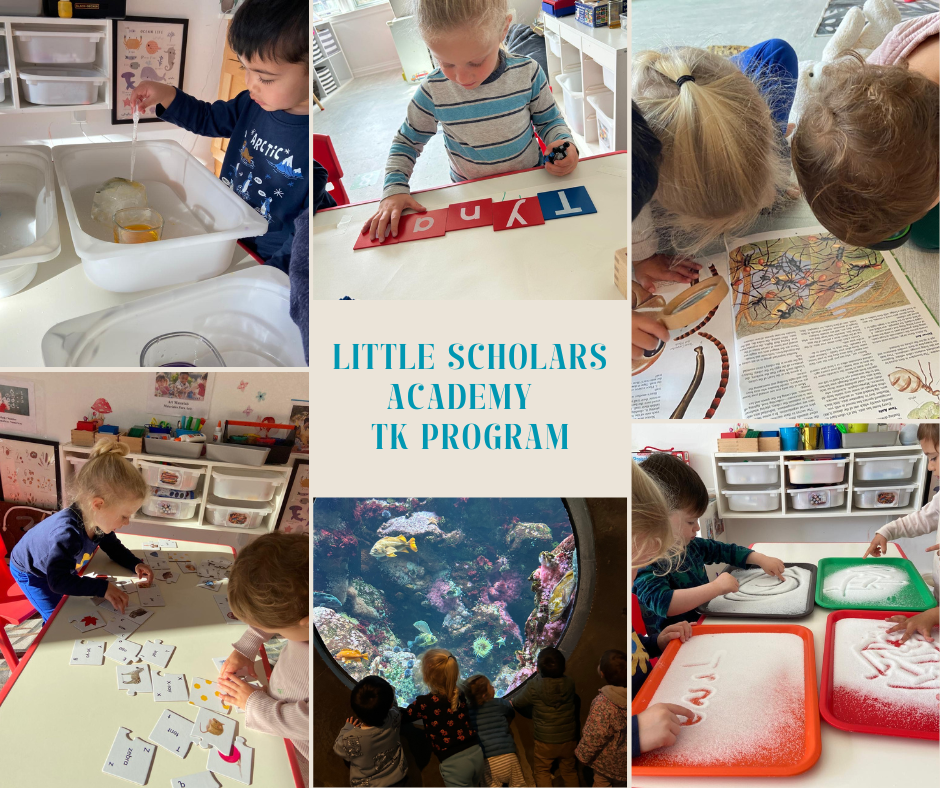
The Transitional Kindergarten (TK) program serves as a bridge between preschool and kindergarten, designed to support children ages 4 to 5 years as they build the foundational academic and social–emotional skills needed for Elementary school.
We will focus on a developmentally appropriate, project based curriculum that integrates early literacy, numeracy, science exploration, art, and movement.
Education Standards
- Develop school readiness skills — including early reading, writing, number sense, and self-regulation.
- Foster collaboration, creativity, and communication through interactive, project-based learning and presentations.
- Develop emotional awareness, self-regulation, and peaceful conflict-resolution skills in a small-group environment.
Support a smooth transition into kindergarten by introducing students to topics they will encounter in kindergarten
dAILY SCHEDULE
| Time | Topic | Example |
| 8:50am- 9:15am | Arrival & Free Exploration | |
| 9:15am- 9:30am | Morning circle & mindfulness | Welcome song, calendar, weather, movement, and community sharing. Introducing theme for the day/week or planed project |
| 9:30am- 10am | Language lesson | Identifying letters, sounds, syllables. Beginning tracing and hand writing |
| 10am- 10:20am | Snack | |
| 10:20am- 11:00am | STEM activity | Thematic, hands-on projects aligned with monthly learning units—including garden science,introduction to addition and subtraction, health and hygiene, basic anatomy, space science etc. |
| 11am- 12:30pm | Outdoor time | Rotational visits to: St.Marys Park (2x week), Glen Park Canyon (2x week), Glen Park library (1x week). Fridays are field trip days! |
| 12:30- 12:50pm | Lunch | Organic home made meals + Milk |
| 12:50- 2:30pm | Quiet time/ optional nap/ independent work | Resting cots provided to students that still nap. Older TK students can work on a guided quiet activity: reading, puzzle or drawing. |
| 2:30 – 3:30pm | Storytime, music, art and movement activity | Group movement/ Dance class, rhythm, music, and mindfulness activities. |
| 3:30pm- 3:50pm | Afternoon snack | |
| 3:50pm-4:15pm | Outdoor activity/recess | Backyard games and activity/ free play |
| 4:15pm – 4:50pm | Reflection and community circle | Weekly show and tell presentations Learning recall from the day. Homework review and assignment |
| 4:50pm -5:00pm | Free play and pick up |
Math Goals
- Strengthen visual-spatial and problem-solving skills through hands-on group projects.
- Build number sense: count objects
- Recognize numbers 1–20 (age 3) and up to 50 (age 4–5).
- Sort and classify objects by color, shape, size, or type.
- Recognize simple patterns
- Identify shapes and describe shapes using simple language (sides, corners)
- Compare objects using early measurement concepts: bigger/smaller, heavier/lighter, longer/shorter
- Develop early addition and subtraction skills using real objects. Understand simple addition as “putting together” Understand subtraction as “taking away” Solve simple problems using objects (e.g., “You have 3 blocks, I give you 2 more…”)
Science Goals
- Explore basic life science (plants, animals, weather).
- Develop curiosity through collaborative hands-on group activity
- Observe, ask questions, and describe simple cause-and-effect (e.g., what sinks/what floats).
- Group projects: ex: work as a group to develop a tower that can hold the weight of a tennis ball, Egg drop, students will build a protective covering for an egg.
- Use senses to compare features: texture, sound, weight, temperature.
Technology Goals
- Understand that technology helps us learn, communicate, and solve problems.
Use simple tools safely (magnifiers, droppers, flashlights, calculators,). - Practice early digital literacy with age-appropriate devices (eg. taking photos, using a microscope, audio devices, basic coding toys (screen-free)
Engineering goals
- Build and design with blocks, Magna-Tiles, LEGOs, and recycled materials.
- Test structures for strength, height, balance, and stability.
- Practice planning, trying, revising — early problem-solving and iteration.
Art goals
- Learning to describe their artwork
- Holding crayons/brushes with emerging fine-motor control
- Naming colors & shapes
- Pattern and texture recognition
- Using art vocabulary: line, dot, swirl, circle, warm/cool colors
Dance– 2x month enrichment class
- Build body awareness (where is my body in space?)
- Practice rhythmic timing
- Improve listening & following instructions
- Strengthen confidence & self-expression
- Encourage cooperation & group movement
- Work toward end of semester class show (parents are encouraged to come watch!)
Music– 2x month enrichment class
- Dedicated music class led by a music specialist to help students develop singing, rhythm, movement, and instrument exploration.
Field Trips
- Friday Rotating trips to:
- Exploratorium
- Academy of Science
- Hawk hill Farm
- Alameny Farm
- SF Zoo
- Randall Museum
- Children Botanical Garden
- Outpost park
- During each outing, students will receive a fun, age-appropriate learning sheet connected to our current thematic unit. These worksheets are designed to support intentional observation, inquiry-based learning, vocabulary development, and meaningful engagement during these class trips.
Presentations
- Weekly Show and tell presentation: Students will bring one object or experience from home to present to their friends.
- Biannual poster presentation: Students select a topic they’re curious about, spend 1–2 months discovering more about it, and then design a poster to proudly teach their classmates what they’ve learned.
Homework
- Weekly homework folders will be provided on Fridays and the class will go through it together the following Friday in the afternoon.
- The goal of homework is to build curiosity, support language development and practice motor skills.
- Most homework packets should take less than 10 min a day and it’s a way for parents to participate in what they are learning in school in a home setting.
- Examples:
- Reading with an adult
- Sort laundry by color
- Count fruit at the grocery store
- Set the table
- Match socks
- Help measure ingredients